


|
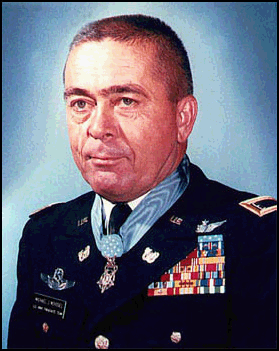
NOVOSEL, MICHAEL J. Rank and organization: Chief Warrant Officer, U.S. Army, 82d Medical Detachment, 45th Medical Company, 68th Medical Group Place and date: Kien Tuong Province, Republic of Vietnam, 2 October 1969 Entered service at: Kenner, Louisiana Born: 3 September 1922, Etna, Pennsylvania Citation: For conspicuous gallantry and intrepidity in action at the risk of his life above and beyond the call of duty. CWO Novosel, 82d Medical Detachment, distinguished himself while serving as commander of a medical evacuation helicopter. He unhesitatingly maneuvered his helicopter into a heavily fortified and defended enemy training area where a group of wounded Vietnamese soldiers were pinned down by a large enemy force. Flying without gunship or other cover and exposed to intense machine gun fire, CWO Novosel was able to locate and rescue a wounded soldier. Since all communications with the beleaguered troops had been lost, he repeatedly circled the battle area, flying at low level under continuous heavy fire, to attract the attention of the scattered friendly troops. This display of courage visibly raised their morale, as they recognized this as a signal to assemble for evacuation. On 6 occasions he and his crew were forced out of the battle area by the intense enemy fire, only to circle and return from another direction to land and extract additional troops. Near the end of the mission, a wounded soldier was spotted close to an enemy bunker. Fully realizing that he would attract a hail of enemy fire, CWO Novosel nevertheless attempted the extraction by hovering the helicopter backward. As the man was pulled on aboard, enemy automatic weapons opened fire at close range, damaged the aircraft and wounded CWO Novosel. He momentarily lost control of the aircraft, but quickly recovered and departed under the withering enemy fire. In all, 15 extremely hazardous extractions were performed in order to remove wounded personnel. As a direct result of his selfless conduct, the lives of 29 soldiers were saved. The extraordinary heroism displayed by CWO Novosel was an inspiration to his comrades in arms and reflect great credit on him, his unit, and the U.S. Army. |
 |
For conspicuous gallantry and intrepidity in action at the risk of his life above and beyond the call of duty. Sgt. Sammy Lee Davis (then Pfc.) distinguished himself during the early morning hours of November 18, 1967 while serving as a cannoneer with Battery C, at a remote fire support base. At approximately 0200 hours the fire support base was under heavy enemy mortar attack. Simultaneously, an estimated reinforced Viet Cong battalion launched a fierce ground assault upon the fire support base. The attacking enemy drove to within 25 meters of the friendly positions. Only a river separated the Viet Cong from the fire support base. Detecting a nearby enemy position, Sgt. Davis seized a machine gun and provided covering fire for his gun crew, as they attempted to bring direct artillery fire on the enemy. Despite his efforts, an enemy recoilless-rifle round scored a direct hit upon the artillery piece. The resultant blast hurled the gun crew from their weapon and blew Sgt. Davis into a foxhole. He struggled to his feet and returned to the howitzer, which was burning furiously. Ignoring repeated warnings to seek cover, Sgt. Davis rammed a shell into the gun. Disregarding a withering hail of enemy fire directed against his position, he aimed and fired the howitzer which rolled backward, knocking Sgt. Davis violently to the ground. Undaunted, he returned to the weapon to fire again when an enemy mortar round exploded within 20 meters of his position, injuring him painfully. Nevertheless, Sgt. Davis loaded the artillery piece, aimed, and fired. Again he was knocked down by the recoil. In complete disregard for his safety, Sgt. Davis loaded and fired three more shells into the enemy. Disregarding his extensive injuries and his inability to swim, Sgt. Davis picked up an air mattress and struck out across the deep river to rescue three wounded comrades on the far side. Upon reaching the three wounded men, he stood upright and fired into the dense vegetation to prevent the Viet Cong from advancing. While the most seriously wounded soldier was helped across the river, Sgt. Davis protected the two remaining casualties until he could pull them across the river to the fire support base. Though suffering from painful wounds, he refused medical attention, joining another howitzer crew which fired at the large Viet Cong force until it broke contact and fled. Sgt. Davis' extraordinary heroism, at the risk of his life, is in keeping with the highest traditions of the military service and reflect great credit upon himself and the U.S. Army. |
 |
On Feb. 24, 1969, Airman First Class John L. Levitow became the lowest-ranking member of the Air Force to earn a Medal of Honor. Levitow was the Loadmaster of an AC-47 gunship in Vietnam when his aircraft was struck by a mortar round. The explosions left holes in the aircraft, burned through the floor to the aircraft's control cables, and wounded the crew, including Levitow. Levitow, suffering over 40 fragment wounds, reacted quickly and crawled to the flare, and threw himself upon it. Hugging it to his body, he dragged himself back to the rear of the cabin and pushed it through the open cargo door an instant before it ignited, saving the aircraft and its crew. When the aircraft finally returned to the base, the AC-47 had more than 3,500 holes in the wings and fuselage, one measuring more than three feet long. For his exceptional acts of heroism during that wartime, John Levitow was awarded the Medal of Honor by Pres. Richard Nixon in May 1970. On November 8, 2000, Levitow died of cancer and was buried at Arlington National Cemetery. We are extremely thankful to A1C Levitow for his incredible service. |
 |
From April 10 - 13, 1972, Lt. Thomas Rolland Norris completed an unprecedented ground rescue of two downed pilots deep within heavily controlled enemy territory in Quang Tri Province. Lt. Norris, on the night of 10 April, led a five-man patrol through 2,000 meters of heavily controlled territory, located one of the downed pilots at daybreak, and returned to the Forward Operating Base (FOB). On 11 April, after a devastating mortar and rocket attack on the small FOB, Lt. Norris led a three-man team on two unsuccessful rescue attempts for the second pilot. On the afternoon of the 12th, a forward air controller located the pilot and notified Lt. Norris. Dressed in fishermen disguises and using a sampan, Lt. Norris and one Vietnamese traveled throughout the night and found the injured pilot at dawn. Covering the pilot with bamboo and vegetation, they began the return journey, successfully evading a North Vietnamese patrol. Approaching the FOB, they came under heavy machine-gun fire. Lt. Norris called in an air strike which provided suppression fire and a smoke screen, allowing the rescue party to reach the FOB. By his outstanding display of decisive leadership, undaunted courage, and selfless dedication in the face of extreme danger, Lt. Norris enhanced the finest traditions of the U.S. Naval service. |
 |
For conspicuous gallantry and intrepidity at the risk of his life above and beyond the call of duty while participating in a daring operation against enemy forces. On October 31, 1972, PO Thornton, as assistant U.S. Navy adviser, along with a U.S. Navy lieutenant serving as senior adviser, accompanied a three-man Vietnamese Navy SEAL patrol on an intelligence-gathering and prisoner capture operation against an enemy-occupied naval river base. Launched from a Vietnamese Navy junk in a rubber boat, the patrol reached land and was continuing on foot toward its objective when it suddenly came under heavy fire from a numerically superior force. The patrol called in naval gunfire support and then engaged the enemy in a fierce firefight, accounting for many enemy casualties before moving back to the waterline to prevent encirclement. Upon learning that the senior adviser had been hit by enemy fire and was believed to be dead, PO Thornton returned through a hail of fire to the lieutenant's last position, quickly disposed of two enemy soldiers about to overrun the position, and succeeded in removing the seriously wounded and unconscious Senior Naval Advisor to the water's edge. He then inflated the lieutenant's lifejacket and towed him seaward for approximately two hours until picked up by support craft. By his extraordinary courage and perseverance, PO Thornton was directly responsible for saving the life of his superior officer and enabling the safe extraction of all patrol members, thereby upholding the highest traditions of the U.S. Naval Service. |